Create Equations for Summation to Find Quick and Easy
 Download Article
Download Article
An arithmetic sequence is a series of numbers in which each term increases by a constant amount. To sum the numbers in an arithmetic sequence, you can manually add up all of the numbers. This is impractical, however, when the sequence contains a large amount of numbers. Instead, you can quickly find the sum of any arithmetic sequence by multiplying the average of the first and last term by the number of terms in the sequence.
-
1
Make sure you have an arithmetic sequence. An arithmetic sequence is an ordered series of numbers, in which the change in numbers is constant.[1] This method only works if your set of numbers is an arithmetic sequence.
- To determine whether you have an arithmetic sequence, find the difference between the first few and the last few numbers. Ensure that the difference is always the same.
- For example, the series 10, 15, 20, 25, 30 is an arithmetic sequence, because the difference between each term is constant (5).
-
2
Identify the number of terms in your sequence. Each number is a term. If there are only a few terms listed, you can count them. Otherwise, if you know the first term, last term, and common difference (the difference between each term) you can use a formula to find the number of terms. Let this number be represented by the variable .
- For example, if you are calculating the sum of the sequence 10, 15, 20, 25, 30, , since there are 5 terms in the sequence.
Advertisement
-
3
Identify the first and last terms in the sequence. You need to know both of these numbers in order to calculate the sum of the arithmetic sequence. Often the first numbers will be 1, but not always. Let the variable equal the first term in the sequence, and equal the last term in the sequence.


Advertisement
-
1
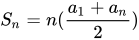
Set up the formula for finding the sum of an arithmetic sequence. The formula is , where equals the sum of the sequence.[2]
- Note that this formula is indicating that the sum of the arithmetic sequence is equal to the average of the first and last term, multiplied by the number of terms.[3]
-
2
-
3
Calculate the average of the first and second term. To do this, add the two numbers, and divide by 2.
-
4
Multiply the average by the number of terms in the series. This will give you the sum of the arithmetic sequence.

Advertisement
-
1
Find the sum of numbers between 1 and 500. Consider all consecutive integers.
-
2
Find the sum of the described arithmetic sequence. The first term in the sequence is 3. The last term in the sequence is 24. The common difference is 7.
-
3
Solve the following problem. Mara saves 5 dollars the first week of the year. For the rest of the year, she increases her weekly savings by 5 dollars every week. How much money does Mara save by the end of the year?
Advertisement
Add New Question
-
Question
How can I determine whether the sequence is arithmetic?

A sequence is arithmetic if there is a constant difference between any term and the terms immediately before and after it: for example, if each term is 7 more than the term before it.
-
Question
Why do I need to divide by 2?

You do this so that you can find the average of the two numbers. For example, if you were finding the average between 7, 12, and 8, you would add them up (27) and divide them by the number of values you have. In this case, you have three numbers, so you'd divide 27 by 3 to get an average of 9. In the case of the sum of an arithmetic sequence, you have two numbers that you are finding the average of, so you divide it by the amount of values you have, which is two.
-
Question
What is the sum of all integers from 1 to 50?

LyKaxandra Caimoy
Community Answer
You will find that 1 + 50 = 2 + 49 = 3 + 48 (and so on). Multiply the sum, which is 51, by half of the last term. You have the equation 51 × 25 = 1275. The sum is therefore 1275.


See more answers
Ask a Question
200 characters left
Include your email address to get a message when this question is answered.
Submit
Advertisement
Video
Thanks for submitting a tip for review!
About This Article
Article Summary X
To find the sum of an arithmetic sequence, start by identifying the first and last number in the sequence. Then, add those numbers together and divide the sum by 2. Finally, multiply that number by the total number of terms in the sequence to find the sum. To see example problems, scroll down!
Did this summary help you?
Thanks to all authors for creating a page that has been read 563,061 times.
Did this article help you?
Source: https://www.wikihow.com/Find-the-Sum-of-an-Arithmetic-Sequence
0 Response to "Create Equations for Summation to Find Quick and Easy"
Post a Comment